Trailblazer: First Pakistani Scientist Receives Digital Green Talent Award
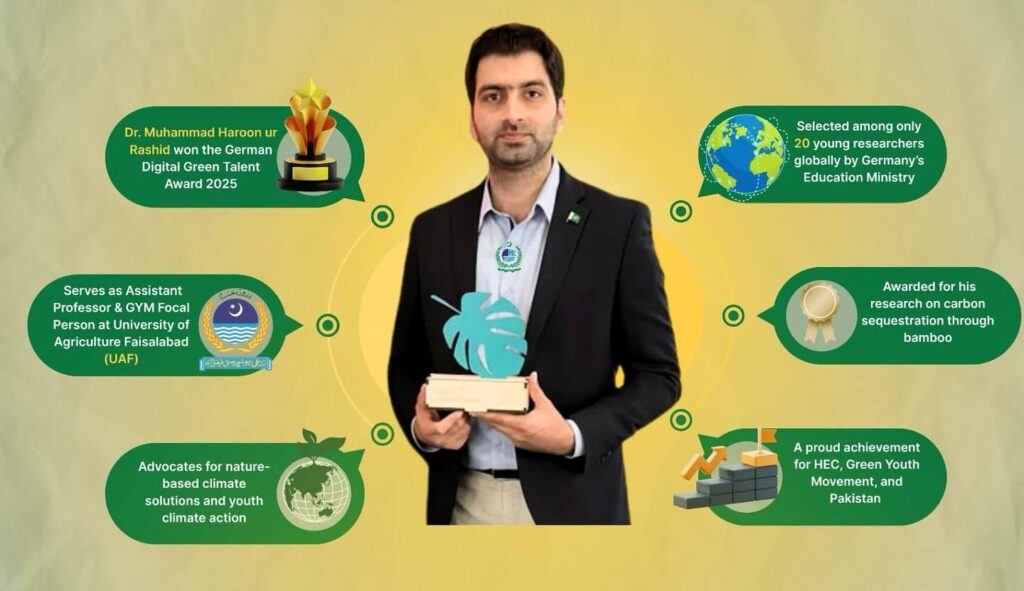
In a remarkable achievement for Pakistan, Dr. Muhammad Haroon Rashid, Assistant Professor at the Department of Forestry and Range Management, University of Agriculture Faisalabad (UAF), has been honoured with the Digital Green Talent Award by Germany’s Federal Ministry of Education and Research. This prestigious international recognition is awarded annually to 20 exceptional young scientists worldwide for their outstanding contributions to sustainable development. Dr. Haroon is the only Pakistani among this year’s awardees.
Holding a Ph.D. in Forest Ecology, Dr. Haroon received this award for his groundbreaking work in sustainable forestry and climate change mitigation. His research focuses on bamboo-based carbon sequestration projects, a first of its kind in Pakistan, and promoting agroforestry practices to combat climate change.
International Recognition and National Awards
Recently, Dr. Haroon was also awarded the Youth Excellence Award by Prime Minister Shehbaz Sharif for his contributions to environmental research. Over the years, he has participated in research initiatives in Germany, the United States, and China. Notably, he was part of a U.S. Department of Agriculture-funded project at Michigan State University, “Trees Outside Forests,” which explored strategies to increase green cover beyond conventional forests.
“I had the privilege to work with Nobel Laureate Dr. David Spoak during this project,” Dr. Haroon shared. “We examined the carbon sequestration potential of farm-grown trees—a largely unexplored area in Pakistan.”
Driving Innovation in Forestry with Digital Tools
During his stay in Germany, Dr. Haroon acquired expertise in advanced digital tools such as Remote Sensing and GIS technologies, which allow real-time forest monitoring and future planning.
“These tools help us visualize live forest data and design better strategies for sustainable management,” he explained. “I also learned cutting-edge techniques for plant phenotyping, which will significantly enhance our ability to study species under changing climates.”
Bamboo: The Unsung Hero in Carbon Sequestration
A major focus of Dr. Haroon’s research is on bamboo, the fastest-growing plant in the grass family, known for its minimal resource requirements.
“Bamboo doesn’t need fertilizers or special soil preparation and thrives in various conditions,” he said. “It absorbs more carbon and heavy metals than most plants, making it a game-changer for climate resilience.”
While some progressive farmers in Pakistan have already adopted bamboo cultivation for profit, most remain unaware of its economic and environmental potential.
“To bridge this gap, we’ve initiated research trials,” Dr. Haroon noted. “Within four to five months, we expect publishable results that will guide farmers and policymakers on large-scale bamboo integration.”
Aligning Research with Carbon Credit Programs
Dr. Haroon praised the Chief Minister Punjab Green Credit Program (CMPGCP), which incentivizes citizens to reduce carbon emissions.
“Our research will help farmers participate in carbon credit markets by planting bamboo,” he said. “This will not only contribute to climate change mitigation but also create new income streams for rural communities.”
A Vision for the Future
Looking ahead, Dr. Haroon plans to expand agroforestry and tree-based farming practices across Pakistan, backed by evidence-based research.
“With minimal inputs and maximum outputs, bamboo offers a sustainable solution to climate change,” he emphasized. “It’s time to transform our agricultural landscapes into climate-smart ecosystems.”