Punjab Leads the Way in Climate Action: A Provincial Comparison

Punjab under Chief Minister Maryam Nawaz Sharif has emerged as a national leader in climate governance and budgetary commitment for environmental sustainability. The province’s 2025–26 budget has taken a bold and comprehensive approach to climate action, setting a benchmark for the rest of Pakistan.
Punjab’s Climate Investment: Rs 795 Billion Climate-Tagged Budget
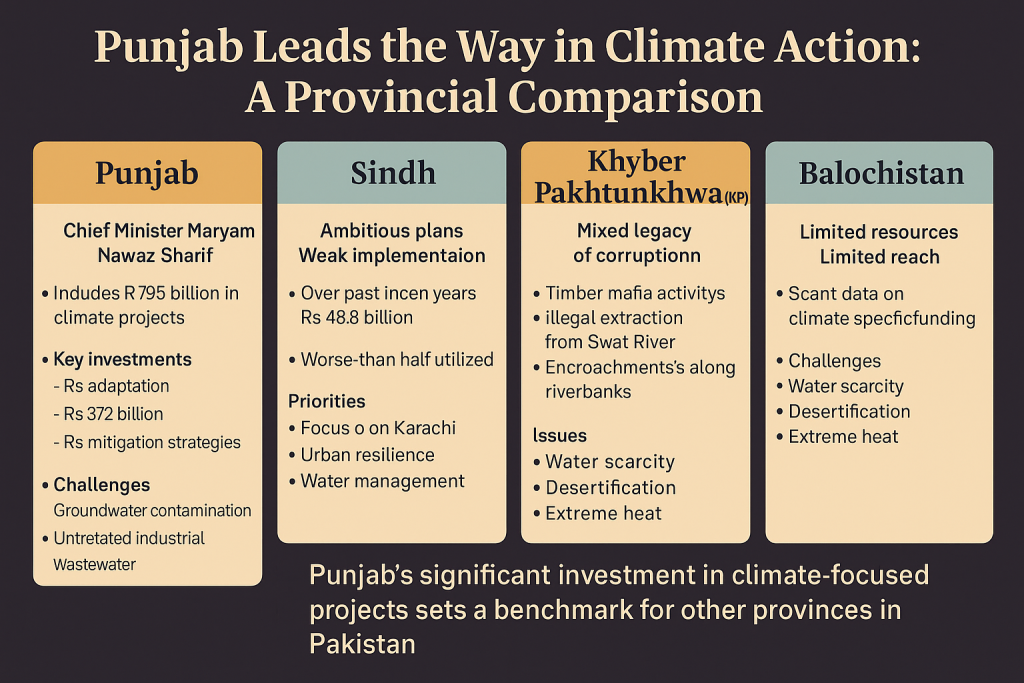
Punjab has allocated an estimated Rs 795 billion in climate-tagged development programs, with approximately Rs 15 billion directly earmarked for environmental protection and climate resilience. The budget includes Rs 277 billion for climate adaptation, Rs 372 billion for mitigation strategies, and Rs 146 billion for environmental protection. Additionally, Rs 5.7 billion has been allocated for air quality improvements through the Clean Air Program, Rs 3 billion for the establishment of a climate observatory, and over Rs 40 billion for forestation and wildlife protection. A dedicated Rs 1.94 billion has also been assigned to strengthen the provincial environmental protection force.
While these investments are commendable, the Punjab government must now ensure that climate change initiatives are extended beyond Lahore to include other major cities, especially Faisalabad—the province’s second-largest city and a major industrial hub. Faisalabad faces severe environmental challenges, including groundwater contamination, the salinization of water sources, and untreated industrial wastewater discharge. Serious work is needed on projects like rainwater harvesting, large-scale tree plantation, and wastewater treatment infrastructure to reduce carbon emissions and improve water quality. Prioritizing Faisalabad in climate resilience projects is not only an environmental necessity but also vital for public health and sustainable urban development.
Sindh: Ambitious Plans, Weak Implementation
The Sindh government’s budget for 2025-26 includes Rs 1.569 billion for environment and climate change with a focus on climate-resilient agriculture and water management, as well as investments in climate-responsive infrastructure and energy solutions. Sindh has long been vocal about climate vulnerability and has developed ambitious frameworks, allocating Rs 48.8 billion for climate action over the past 16 years. However, implementation remains a serious issue, with reports indicating that less than half of these funds—approximately 41%—have actually been utilized. The province continues to face challenges in converting policy into practical outcomes, particularly in urban resilience and water management.
The provincial government should also prioritize Karachi—one of the world’s largest cities—in climate change projects. There is an urgent need to adopt environmentally friendly urban practices and implement robust infrastructure for climate resilience. Restoration of the Indus River Delta, prevention of encroachments along the coastline, and the installation of wastewater treatment plants to stop untreated sewage and industrial effluents from entering the sea are critical interventions. Additionally, the government must take urgent steps to address water shortages in the Indus River during droughts through better upstream water management and integrated river basin planning.
Khyber Pakhtunkhwa: Mixed Legacy of Conservation and Corruption
The Khyber Pakhtunkhwa government’s budget for 2025–26 allocates Rs 97 million for envoironement-related initiatives, which accounts for just 0.02% of the province’s total development budget. In addition, Rs 4,944.94 million has been allocated for forestry, representing 0.9% of the overall development budget. However, no specific funds have been earmarked for climate change mitigation or adaptation measures, reflecting a lack of targeted planning to address the province’s environmental challenges. Khyber Pakhtunkhwa (KP) initially earned international praise for the Billion Tree Tsunami project, which claimed the plantation and maintenance of over 121 million saplings. While the program was a milestone in forest conservation, it has since been marred by allegations of corruption and embezzlement of funds. Whistleblower reports and internal audits have highlighted ghost plantations, inflated figures, and mismanagement of resources. Furthermore, the provincial government has largely turned a blind eye to the activities of the timber mafia, which continues to undermine genuine conservation efforts.
Illegal extraction of sand and gravel from the Swat River, allegedly with local government support or complicity, has caused serious ecological damage, including riverbank erosion and the destruction of aquatic habitats. Adding to the environmental degradation is the unchecked growth of illegal hotels and commercial encroachments along riverbanks in tourist-heavy areas. These structures not only pollute local water sources but also obstruct the natural flow of rivers, increasing flood risks. Despite its early success, KP’s green legacy now faces critical questions about transparency, sustainability, and environmental justice.
Balochistan: Limited Resources, Limited Reach
The Balochistan government’s budget for 2025–26 allocates Rs 500 million as special funds under Balochistan Climate Change Fund. As Pakistan’s most climate-vulnerable province, continues to struggle due to limited resources and institutional capacity. There is scant data available on climate-specific funding in the 2025–26 budget, and the provincial focus largely remains on general development. The lack of targeted climate finance and capacity development presents a critical gap in safeguarding local communities against water scarcity, desertification, and extreme heat.
The provincial government must also take special measures to protect the natural environment from destruction and shield the local population from climate change impacts. This is particularly crucial as development progresses in Gwadar and other coastal cities. Balancing infrastructure growth with ecosystem preservation will be key to ensuring long-term sustainability and protecting livelihoods.
Conclusion: Punjab Sets the Standard
Punjab’s commitment to climate action both in terms of planning and financing is currently unmatched by any other province in Pakistan. With a forward-looking climate vision, a diversified portfolio of mitigation and adaptation projects, and bold investment in institutional capacity, Punjab is demonstrating the level of urgency and seriousness the climate crisis demands. Other provinces must follow suit by not just allocating funds, but by ensuring that implementation translates these budgets into resilient infrastructure, cleaner air, safer water, and greener futures for all.